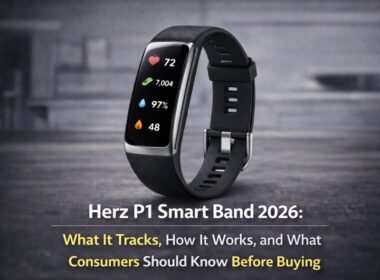
A 2026 Informational Overview of the Herz P1 Smart Band’s Subscription-Free Health Monitoring Features, Heart Rate and HRV Tracking, Sleep Quality Analysis, Blood Oxygen and SpO2 Sensors, Stress and Temperature Monitoring, 30-Day Battery Life Claims, Companion App Functionality, Pricing Structure, Return Policy Terms, Sensor Technology Explained, Water Resistance Specifications, and What Consumers Should Independently Verify Before Purchasing Any Fitness Tracker or Wearable Health DeviceAkron, OH, Feb. 26, 2026 (GLOBE NEWSWIRE) — This article is for informational purposes only. The Herz P1 Smart Band is a consumer wellness product and is not a medical device. It is not intended to diagnose, treat, cure, or prevent any disease or medical condition. Consumers should consult a qualified healthcare professional before making health decisions based on data from any wearable device. This article contains affiliate links. If you click through and make a purchase, a commission may be earned at no additional cost to you. This compensation does not influence the accuracy or integrity of the information presented. The consumer wearable market continues to expand in 2026, with fitness trackers, smart bands, and health monitoring devices competing for attention across a crowded category. For consumers researching their options, sorting through feature claims, pricing models, and subscription structures can feel overwhelming. The Herz P1 Smart Band is one product that’s entered this space, marketed as a subscription-free wrist-worn health tracker with a long battery life and multi-metric monitoring capabilities. This informational overview examines what the Herz P1 Smart Band offers, how its features are described by the company, what the pricing structure looks like, and what consumers should independently verify before purchasing any fitness wearable in this category. The wearable technology space moves quickly, and product specifications, pricing, and availability can change without notice. Any product details are described as stated by the company and should be verified on the official site and directly with the manufacturer. The Herz P1 Smart Band is a consumer wellness product, not an FDA-cleared or FDA-approved medical device, and health monitoring results are not guaranteed. The information below is compiled from publicly available materials and does not represent clinical evaluation, independent laboratory testing, or editorial endorsement of the product or company. To view the current Herz P1 Smart Band offer (official Herz P1 page), consumers can check the complete product details, pricing, and return policy directly. What the Herz P1 Smart Band Is The Herz P1 Smart Band is a wrist-worn consumer wellness and fitness tracker manufactured by WuzuTech LLC, a company based in Akron, Ohio. The company positions the device as a general wellness tool designed for continuous 24/7 health monitoring. It is not classified as a medical device, and the company’s own health disclaimer states that the product and related services “are for general wellness and fitness purposes only and are not intended to be used as a medical device or to replace professional medical advice, diagnosis, or treatment.” The company states that the Herz P1 Smart Band tracks over 20 health and activity metrics using optical heart rate sensors, motion sensors, and temperature sensors built into the device. Data from the band syncs to the Herz companion app, which is available on both iOS and Android. Per the company’s published materials, the device is a one-time purchase with no recurring subscription fees required to access health data or app features. Wearable products in this category use different pricing and app-access models — some include subscription-based features, while others are offered as one-time purchases. Consumers can verify current access terms on the official product page. Regulatory Classification and General Wellness Wearables In the United States, some consumer wearables are marketed as “general wellness” products. The FDA has published guidance describing its enforcement policy for low-risk general wellness products and how they differ from devices intended for diagnosis or treatment. These products may provide estimates and trend insights related to activity and wellness but aren’t intended to diagnose, treat, cure, or prevent disease. The company markets the Herz P1 Smart Band for general wellness and fitness purposes, and states it is not intended to be used as a medical device or to replace professional medical advice. This means the data it provides — heart rate estimates, sleep pattern approximations, SpO2 readings, and activity metrics — should be understood as trend indicators, not clinical measurements. Consumers should avoid using wearable readings as a substitute for clinical evaluation, especially for medical decisions involving heart conditions, oxygenation concerns, unusual temperature patterns, or sleep disorders. Anyone with specific health concerns should consult a licensed healthcare provider who can recommend appropriate monitoring tools. How the Herz P1 Smart Band Works The company’s materials describe the device as using a combination of sensor technologies to collect biometric and activity data from the wearer’s wrist throughout the day and night. The collected data is transmitted via Bluetooth to the Herz companion app (also referenced as QRing), where it’s organized into reports and insights. Optical Heart Rate Sensors — the company states these continuously monitor heart rate and heart rate variability (HRV), providing data on cardiovascular patterns during both active and resting periods. Motion Sensors — accelerometer technology is described as tracking steps, distance, calories burned, and activity intensity throughout the day. Temperature Sensors — the company’s documentation references continuous skin temperature monitoring, which is described as helping users identify patterns related to recovery and overexertion. Blood Oxygen (SpO2) Monitoring — the device is described as measuring blood oxygen saturation levels, which the company frames as relevant to understanding energy levels and respiratory patterns. Per the company’s website, the band also includes stress tracking capabilities and sleep analysis features that monitor sleep stages and quality metrics overnight. What the Herz P1 Smart Band Tracks Based on publicly available information from the company, the Herz P1 Smart Band is described as monitoring the following categories of health and activity data: Heart Rate and HRV — continuous heart rate monitoring and heart rate variability tracking, which the company describes as useful for understanding recovery and cardiovascular health patterns over time. Sleep Quality and Analysis — the company states the band monitors sleep patterns overnight and provides sleep quality insights through the companion app. Blood Oxygen (SpO2) — the device is described as tracking blood oxygen saturation, with data accessible through the app. Skin Temperature — continuous temperature monitoring is referenced in the company’s feature descriptions. Stress Tracking — the company’s materials describe real-time stress monitoring that shows when the body is under strain and how it recovers. Activity Metrics — steps, distance, and calories burned are described as core tracking features. Women’s Health Insights — the company references menstrual cycle tracking capabilities that provide insights into how the cycle affects energy, sleep, and mood. All tracking capabilities described above come from the manufacturer’s publicly available materials. Wrist-worn consumer wellness devices use sensor technologies that provide estimates and trend data — not clinical measurements. Accuracy can vary based on device fit, skin type, motion, environmental conditions, and individual physiology. Consumers who need medically reliable biometric data should consult with a healthcare provider about appropriate monitoring tools. Pricing and Purchase Structure The Herz P1 Smart Band is sold as a one-time purchase through the company’s official website. Wearable products in this category use different pricing models — some require recurring subscriptions to unlock full feature access, while others include all features with a one-time purchase. The company states the Herz P1 Smart Band doesn’t require a recurring subscription to access its companion app features. According to publicly available information on the official website at the time of publication, pricing may vary based on promotions, bundles, and inventory conditions. Consumers should check the official Herz P1 page to confirm the most current pricing, shipping costs, and policy terms before making any purchase decision. The company’s materials state that the purchase includes the smart band, charging cable, and straps. Additional color bands may be sold separately. The company references a 90-day return policy on its official page. Consumers should verify eligibility requirements, timelines, and return shipping responsibilities directly in the published policy before purchasing. Battery Life, Build Quality, and Design The company states the Herz P1 Smart Band contains a 175 mAh battery and describes the following performance characteristics: Active Use Battery Life — the company states up to 25–30 days of regular use on a single charge. Standby Battery Life — up to 60 days of standby time is referenced in the company’s materials. Charging Time — the company states the device fully recharges in approximately 1 to 1.5 hours. Regarding build quality, the company’s documentation describes the device as constructed from a lightweight zinc alloy frame with a durable nylon strap. The company states the band is water-resistant and sweat-proof, suitable for workouts and daily wear. The company’s official product page references water resistance but advises against swimming or full submersion. The Herz P1 Smart Band is described as available in five color options: Midnight Black, Frosted White, Green Power, Navy Blue, and Rose Mist. Battery life and water resistance claims come from the manufacturer. Actual performance may vary based on notification settings, sensor sampling frequency, Bluetooth connectivity, display behavior, device fit, and environmental conditions. Consumers should check the complete product specifications on the official site before purchasing. Companion App and Data Access The company states that the Herz P1 Smart Band syncs with a companion app available for both iOS and Android. The app is described as providing detailed health and fitness reports, goal-setting features, and progress tracking over time. Per the company’s materials, the app supports over 30 languages. The band also includes offline data storage. The company states that if Bluetooth is disconnected, the device can store health data locally for several days. Once reconnected, stored data syncs automatically with the companion app. Consumers should verify app compatibility with their specific device and operating system version before purchasing. What Consumers Commonly Verify Before Purchasing Based on common consumer research patterns in the wearable technology category, here are areas that prospective buyers typically investigate before purchasing a fitness tracker: Accuracy Expectations: Consumer wellness wearables vary in accuracy across different metrics. No wrist-worn consumer device provides clinical-level precision. The company states its device tracks various metrics, but consumers seeking medically reliable data should consult a healthcare provider. Return Policy Terms: The company references a 90-day return policy on its official page. Consumers should verify the specific terms, conditions, and process for returns directly on the company’s website before purchasing. Company Background: WuzuTech LLC is listed as the manufacturer, based in Akron, Ohio. Consumers can verify the company’s business registration, customer service responsiveness, and fulfillment track record independently. App Functionality: Checking the companion app’s current version, update frequency, and user feedback in the iOS App Store or Google Play Store before purchasing can provide additional perspective on the overall experience. Comparison Shopping: Consumers often compare wearables based on sensor types, sampling frequency, battery life under real-world settings, return policy clarity, app permissions, and whether full feature access requires ongoing fees. Evaluating multiple products across these criteria helps inform a purchasing decision. Water Resistance vs. Waterproofing: The company describes the device as water-resistant and suitable for sweat and splashes but advises against swimming or full submersion. Consumers should understand the difference between water resistance ratings before wearing any device in water. Key Terminology for the Consumer Wearable Category Heart Rate Variability (HRV): HRV measures the time variation between heartbeats. In consumer wellness contexts, it’s commonly used as an indicator of recovery and stress. HRV readings from consumer wearables are estimates and shouldn’t be used for medical diagnosis. Blood Oxygen Saturation (SpO2): SpO2 refers to the percentage of oxygen-carrying hemoglobin in the blood. Consumer wearable SpO2 readings are approximations and aren’t equivalent to pulse oximeter readings obtained in clinical settings. Photoplethysmography (PPG): PPG is the optical sensor technology commonly used in consumer wearables to detect blood volume changes beneath the skin. It’s the foundational technology behind heart rate and SpO2 monitoring in most fitness trackers and smart bands. General Wellness Device: A category described in FDA guidance for products intended to promote a healthy lifestyle. General wellness devices aren’t intended to diagnose, treat, cure, or prevent disease and don’t follow the same regulatory pathway as medical devices. Subscription-Free Model: In the wearable category, some manufacturers require monthly or annual subscriptions to access full data insights and features. Subscription-free models provide full feature access with a one-time purchase. Fitness Tracker vs. Smartwatch: A fitness tracker or smart band typically focuses on health and activity monitoring with a lighter design and longer battery life. Smartwatches generally offer broader app functionality, larger displays, and shorter battery life. The Herz P1 Smart Band falls into the fitness tracker and smart band category. Consumer Questions About the Herz P1 Smart Band Is the Herz P1 Smart Band a medical device? No. The company explicitly states that the Herz P1 Smart Band is a general wellness and fitness product. It isn’t intended to diagnose, treat, cure, or prevent any disease or medical condition. The company’s health disclaimer directs consumers to consult a qualified healthcare professional for medical advice. Who manufactures the Herz P1 Smart Band? The Herz P1 Smart Band is manufactured by WuzuTech LLC, a company based in Akron, Ohio. Consumers can verify the company’s business details and contact information independently. Does the Herz P1 Smart Band require a monthly subscription? The company states that no subscription is required. All health data and app features are described as accessible with the one-time device purchase. Consumers should verify this on the official website, as company policies can change. What phone compatibility does the Herz P1 Smart Band support? The company states the device works with both iOS and Android devices through a free companion app. Consumers should verify specific operating system version requirements before purchasing. How long does the Herz P1 Smart Band battery last? The company states up to 25–30 days of regular use on a single charge, with up to 60 days of standby time. Actual battery performance may vary based on usage patterns and settings. The company states charging takes approximately 1 to 1.5 hours. Is the Herz P1 Smart Band waterproof? The company describes the device as water-resistant and suitable for sweat, rain, and hand-washing. However, the company advises against swimming or fully submerging the device. Consumers should check the specific water resistance rating on the official product page. What metrics does the Herz P1 Smart Band track? The company states the device tracks over 20 health and activity metrics, including heart rate, HRV, SpO2, temperature, sleep quality, stress levels, steps, distance, and calories burned. All accuracy claims come from the manufacturer. Does the Herz P1 Smart Band store data offline? The company states the device can store health data locally for several days if Bluetooth is disconnected. Stored data syncs automatically once Bluetooth is reconnected. What is the return policy for the Herz P1 Smart Band? The company references a 90-day return policy on its official page. Consumers should verify eligibility requirements, timelines, and return shipping responsibilities directly in the published policy before purchasing. How does the Herz P1 Smart Band compare to smartwatches? Smart bands and smartwatches serve different purposes. Smart bands like the Herz P1 generally focus on health and fitness tracking with lighter designs and longer battery life. Smartwatches typically offer broader app ecosystems, larger displays, notification management, and shorter battery life. The right choice depends on individual priorities and what you’re looking for in a wearable. Where can consumers purchase the Herz P1 Smart Band? The company’s official website is the primary direct purchase channel. The product has also been listed on third-party retail platforms. Consumers should verify they’re purchasing from an authorized source. What colors are available for the Herz P1 Smart Band? The company’s materials reference five color options: Midnight Black, Frosted White, Green Power, Navy Blue, and Rose Mist. Availability may vary. Additional Category Context Consumers researching subscription-free fitness trackers often evaluate several areas beyond any single product’s feature list. Understanding how optical wrist sensors estimate heart rate and SpO2, what app privacy and data permissions look like, how battery life performs under real-world conditions, and what return and warranty terms actually require are all part of informed decision-making in this category. This article focuses on those evaluation areas using publicly available product disclosures from the Herz P1 Smart Band manufacturer. Consumers are encouraged to apply the same research approach across any wearable they’re considering. For additional context on the broader Herz P1 product line, a separate informational overview examines the company’s smart ring offering — including its features, pricing, accuracy context, and what consumers should verify before purchasing. Read the full informational analysis here. A separate informational overview also examines the company’s smart scale product, including its 8-electrode BIA sensor technology, body composition metrics, and what consumers should verify about accuracy claims for any home health measurement device. Read the full informational overview here. Both analyses were published for informational purposes and are not endorsements or recommendations. A Consumer Verification Checklist for Any Health-Tracking Wearable Before purchasing any health-tracking wearable — including the Herz P1 Smart Band — consumers can strengthen their decision-making by independently verifying the following areas. This checklist isn’t specific to any single product. It’s a framework that applies across the entire consumer wearable category. Verify the App Name and Developer: Download and check out the companion app before purchasing the hardware. Look at who developed it, when it was last updated, and what the current user feedback looks like. The Herz P1 Smart Band syncs with an app referenced as the Herz app or QRing, available on iOS and Android. Check App Permissions: Before installing any health-tracking app, look at what data permissions it requests. Common requests include Bluetooth, location, health data access, and notification permissions. Understand what data the app collects and how it’s stored or shared. Confirm Data Export Options: Some consumers want to export their health data to share with healthcare providers or use with other platforms. Check whether the companion app allows data export and in what formats before committing to a device ecosystem. Read the Return Policy in Full: Don’t rely on summary language. Read the actual return policy terms, including who pays return shipping, whether the device must be in original packaging, and how refunds are processed. The company states a return policy is available on the official Herz P1 website. Check Warranty Terms: Look at what the warranty covers, how long it lasts, and what the claims process involves. Manufacturer warranties for consumer electronics vary significantly in scope and responsiveness. Understand Sensor Limitations: Consumer wearables use optical sensors (PPG), accelerometers, and temperature sensors that provide estimates — not clinical measurements. Factors like skin tone, tattoos, wrist fit, motion, and environmental temperature can affect reading accuracy across all consumer wearable brands. Clarify Water Resistance vs. Waterproofing: These terms mean different things. Check the specific rating. The Herz P1 Smart Band is described as water-resistant and suitable for sweat and splashes, but the company advises against swimming or full submersion. Test Customer Support Responsiveness: Before purchasing, consider sending a pre-sale question to the company’s support team. Response time and quality can give you a sense of what post-purchase support looks like. Ask About Firmware Updates: Wearable devices often receive firmware updates that can affect performance, features, and battery life. Check whether the manufacturer has a track record of providing updates and how they’re delivered. Confirm Device Compatibility: Verify that your specific phone model and operating system version are compatible with the companion app before purchasing. Compatibility requirements can change with operating system updates. Summary of Key Considerations The Herz P1 Smart Band enters 2026 as a subscription-free consumer wellness wearable in a crowded fitness tracker category. The company’s advertised feature set — including 20+ health metrics, up to 30-day battery life, and no recurring fees — positions it as one option among many for consumers exploring accessible health monitoring. As with any consumer wellness device, prospective buyers should understand that the Herz P1 Smart Band is not a medical device and shouldn’t be used as a substitute for professional medical advice, diagnosis, or treatment. All feature claims, accuracy statements, and performance specifications referenced in this article come from the manufacturer’s publicly available materials and haven’t been independently verified through clinical testing as part of this overview. Consumers interested in the complete product details, current pricing, and return policy can view the current Herz P1 Smart Band offer (official Herz P1 page) directly. Contact Information WuzuTech LLC 839 E Market St, Ste 106 #165 Akron, OH 44305 United States Email: support@wuzutech.com Phone: (866) 479-1629 Website: https://herzp1.com Disclaimers Content and General Wellness Disclaimer: This article is for informational purposes only and does not constitute medical advice, professional health guidance, or a product endorsement. The Herz P1 Smart Band is a consumer wellness product, not a medical device. Statements regarding the product have not been evaluated by the Food and Drug Administration. The device is not intended to diagnose, treat, cure, or prevent any disease or medical condition. Consumers should consult with a qualified healthcare professional before making health-related decisions based on data from any consumer wearable device. All product descriptions, features, and specifications referenced in this article are based on the manufacturer’s publicly available materials and have not been independently verified through clinical testing. Results, Pricing, and Availability Notice: Individual results and experiences with consumer wellness wearables vary based on usage patterns, device fit, individual physiology, environmental conditions, and other factors. No specific outcomes are guaranteed. Pricing referenced in this article reflects publicly available information at the time of publication and is subject to change without notice. Consumers should verify all current pricing, shipping costs, and return policy terms directly on the company’s official website before purchasing. FTC Affiliate Disclosure and Publisher Responsibility: This article contains affiliate links. If you click through these links and make a purchase, a commission may be earned at no additional cost to you. This affiliate relationship does not influence the informational content, accuracy, or editorial independence of this article. The publisher is not responsible for the accuracy of information provided by the manufacturer, changes to the product or its availability, or the consumer’s individual experience with the product or company. Consumers are encouraged to conduct their own research and due diligence before making any purchase decision. CONTACT: Email: support@wuzutech.com
Phone: (866) 479-1629