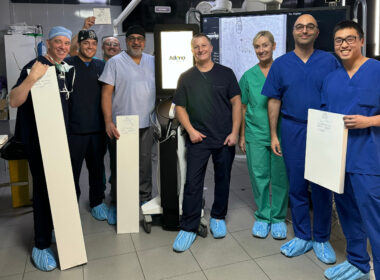
SHANGHAI, July 2, 2024 /PRNewswire/ — Pulnovo Medical Limited, a globally recognized device pioneer in the treatment of Pulmonary Hypertension (PH) and Heart Failure (HF), is pleased to announce the successful initiation and first two patients enrollment for its global multicenter clinical study exploring the percutaneous pulmonary artery denervation (PADN) treatment for pulmonary hypertension associated with left heart disease. This landmark event took place at Centro Hospitalar Universitário de Lisboa Central – Hospital de Santa Marta in Portugal, marking the beginning of Pulnovo Medical’s innovative product deployment on a global scale.
Under the guidance of Professor Hang Zhang from Nanjing Medical University Affiliated Nanjing Hospital, Prof. Ruben Ramos and his team successfully performed the PADN procedure on two patients. The procedure was smooth, the devices easy to operate, and the results were excellent. The Portuguese medical team was impressed by the PADN technology’s safety and efficacy, as demonstrated by many years of data. Clinical parameters showed promising results when using PADN technology. The products’ comprehensive design and high-precision algorithm control significantly ensured stable energy output and effective surgical results.
Prof. Ruben Ramos said, “PADN technology shows great potential in treating pulmonary hypertension associated with left heart disease. We are delighted to be the first in Europe to participate in this global clinical study. Our team is confident in this project and looks forward to bringing more treatment options to European pulmonary hypertension patients through this study. PADN is not only a new treatment method but also brings new hope to patients suffering from pulmonary hypertension.”
Jessie Lian,Pulnovo Medical’s CEO said, “The PADN global multicenter clinical study is one of our key projects dedicated to innovative treatment technologies in the cardiovascular field. As an emerging treatment, PADN has enormous potential and prospects. The post-operative results of the first overseas application of PADN reflect the academic borderlessness of the moment. In the future, we will continue to firmly advance our global business, steadily promoting the teaching and learning of PADN technology. ”
Cynthia Chen, Pulnovo Medical’s Chairlady said, “We are proud to have successfully completed the first enrollment in the European multicenter clinical study of PADN in Portugal, marking the acceleration of our technology’s global progress. We will continue to promote the global application of PADN, allowing more patients to benefit from this innovative therapy.”
Coronary/Structural Heart
Anteris Technologies and v2vmedtech Announce Concept Lock of Next Generation Mitral and Tricuspid Repair System as VClip™ Passes Animal Study
VClip™ restores mitral valve function and overcomes limitations of current technologies July 01, 2024 05:30 AM Eastern Daylight Time BRISBANE, Australia & EAGAN, Minn.–(BUSINESS WIRE)–Anteris Technologies Ltd (ASX: AVR), a structural heart company developing DurAVR™ THV, a new class of TAVR and the world’s only balloon-expandable, single-piece biomimetic aortic replacement valve […]
Merck Receives Positive EU CHMP Opinion for WINREVAIR™ (sotatercept) in Pulmonary Arterial Hypertension (PAH)
If approved by the European Commission, WINREVAIR will be the first activin signaling inhibitor therapy for PAH in Europe, offering a new treatment option for certain adults with this rare, progressive disease Milestone highlights Merck’s focus on global filings to expand access to WINREVAIR and commitment to patients living with […]
Fort Sanders Regional Medical Center First in Tennessee to Adopt New Cardiac Angiogram Technology
KNOXVILLE, Tenn., June 26, 2024 /PRNewswire/ — Fort Sanders Regional Medical Center, a member of Knoxville-based Covenant Health, was the first hospital in the state of Tennessee to adopt revolutionary diagnostic technology that provides clinicians with a patient’s physiology results in just a few minutes.
Coronary heart disease is one of the top killers of adults in the U.S. and particularly the Southeast. Quick diagnosis and intervention are key to treating cardiac patients who are suffering from heart disease, heart attack, or other events causing blockages in arteries that can be life-threatening.
Fort Sanders Regional’s cardiac catheterization lab is staffed around the clock, 24/7, treating both heart patients who have been admitted to the hospital and those who are having outpatient procedures.
When a patient presents with a potential artery blockage, the heart team at Fort Sanders Regional can use a new tool that shows doctors exactly what percentage of an artery is blocked. The CathWorks FFRangio ® System is a computer-based technology that uses routine angiograms (images) of a patient’s heart structure to create a 3D model showing the location and degree of any blockages and their coronary arteries. This helps providers more quickly diagnose and intervene as needed, including determining whether the patient needs a stent and where the stent should be placed in the heart structure.
Fractional flow reserve (FFR) is a diagnostic measurement that evaluates the physiologic impact of coronary artery narrowing due to cholesterol plaque. It is an important part of the decision-making process to decide if a stent placement is indicated and the length of the stent when managing patients with coronary artery disease (CAD).
In contrast to traditional FFR, the FFRangio System combines artificial intelligence (AI) and advanced computational science to obtain quick and reliable FFRangio values from routine angiograms, eliminating the need for drug stimulation and invasive pressure wires. The system provides physicians intraprocedural FFRangio values for all coronary arteries.
Josh Todd, MD, interventional cardiologist at Fort Sanders Regional, said, “With this new tool, interventional cardiologists can perform clinical assessments quicker, more comprehensively, without medications, and in a way that’s seamless and more efficient to the patient. This cutting-edge technology will transform how cardiovascular disease is diagnosed and treated.”
To view the full release, visit https://www.covenanthealth.com/blog/cathworks-technology/.
SOURCE Covenant Health
Rivus Pharmaceuticals Announces Publication of Phase 2a HuMAIN Trial Rationale and Design in European Journal of Heart Failure
– Study evaluating HU6 in patients with obesity-related heart failure with preserved ejection fraction is on track to report topline data in the second half of 2024 –
– HU6, a novel Controlled Metabolic Accelerator, is a new class of investigational medicines designed to reduce weight while preserving muscle –
CHARLOTTESVILLE, Va. and SAN FRANCISCO, June 26, 2024 /PRNewswire/ — Rivus Pharmaceuticals Inc., a clinical-stage biopharmaceutical company dedicated to improving metabolic health, today announced publication of the rationale and design of the company’s Phase 2a HuMAIN trial in the European Journal of Heart Failure. Rivus has completed patient enrollment in this clinical trial of HU6, an investigational Controlled Metabolic Accelerator (CMA), in patients with obesity-related heart failure with preserved ejection fraction (HFpEF) and expects to report topline data in the second half of 2024.
“HuMAIN is the first clinical trial to evaluate the effects of a CMA in patients with obesity-related HFpEF, who have a median survival rate of around two years following hospitalization,” said Jayson Dallas, M.D., chief executive officer, Rivus Pharmaceuticals. “HU6 has the potential to be the first disease-modifying treatment for HFpEF. We look forward to further evaluating the potential benefits of HU6 in this large and growing patient population and sharing topline results in the second half of 2024.”
HFpEF is a chronic debilitating syndrome characterized by severely reduced exercise capacity, which degrades quality of life. Obesity is a major independent risk factor for HFpEF and key contributor to the increasing worldwide prevalence of this disorder, with as many as 80% of patients with HFpEF in Western countries either overweight or obese. Weight loss approaches that involve dieting, bariatric surgery and GLP-1 agonists work by decreasing energy intake rather than by increasing energy expenditure. In addition to loss of fat, these approaches result in marked reductions in muscle mass, which can lead to impaired function in patients with HFpEF, who are typically elderly and frail and already have reduced muscle mass.
“Given the limitations of current options for patients with obesity-related HFpEF, novel disease-modifying treatments are urgently needed,” said Dalane W. Kitzman, M.D., lead author of the publication and professor of internal medicine and cardiovascular medicine at Wake Forest University School of Medicine. “As detailed in this new publication, HU6 reduces fat, which is pivotal to the development of HFpEF, by increasing energy expenditure while preserving muscle. The Phase 2a trial will examine HU6’s potential to improve key outcomes in HFpEF, including increasing exercise capacity and quality of life, reducing systemic inflammation, and improving blood pressure and glucose metabolism.”
About the Phase 2a HuMAIN TrialThe randomized, double-blind, placebo-controlled, parallel-group, dose-escalation Phase 2a HuMAIN study (ClinicalTrials.gov: NCT05284617) is evaluating the safety, tolerability, pharmacodynamics and pharmacokinetics of ascending doses of HU6 (150 mg, 300 mg, 450 mg daily) in patients with obesity-related HFpEF. A total of 65 study participants (37 women and 28 men) age 30 or older with a body mass index (BMI) >30 kg/m2 were randomized to 134 days of daily dosing with HU6 or placebo.
The primary efficacy endpoint is weight reduction (as measured by the change from baseline in body weight at Day 134). The key secondary efficacy endpoint is exercise capacity (as measured by the change from baseline in peak VO2 [mL/kg/min] during a standardized, noninvasive cardiopulmonary exercise test at Day 134). The effects of HU6 on disease-specific quality of life, changes in body composition and cardiac function/structure, and markers of cardiometabolic dysfunction (e.g., changes in blood pressure and pulse, glucose control, inflammation, lipid levels and liver fat and liver enzymes) are also being evaluated. The study is designed to identify the optimal dose of HU6 for Phase 3 trials. HuMAIN is being conducted at 22 clinical sites in the United States.
About Controlled Metabolic Accelerators (CMAs)Rivus is advancing a new class of investigational medicines called Controlled Metabolic Accelerators (CMAs) that have the potential to improve metabolic health for people with obesity and associated metabolic diseases. CMAs are oral small molecules designed to increase resting metabolic rate, which results in increased consumption of energy, primarily from fat. The loss in fat mass addresses multiple cardiometabolic conditions driven by adiposity. CMAs increase metabolism in a continuous and imperceptible manner by leveraging the natural metabolic process of mitochondrial uncoupling. Uncoupling accounts for 20%-40% of resting caloric consumption. A key advantage of this mechanism for increasing energy expenditure is that the resulting weight loss is fat selective with preservation of muscle mass. In contrast, caloric-restriction strategies reduce energy input and result in loss of fat as well as muscle mass. Initial data in humans has demonstrated that CMAs provide fat-selective weight loss, improved insulin sensitivity, and a significant reduction in oxidative stress and inflammation.
About HU6HU6, an oral, once-daily investigational medicine, is Rivus’ lead CMA. It is a purposely designed investigational oral small molecule that is intended to be a foundational monotherapy for cardiac, liver, diabetes and obesity indications. HU6 promotes sustained weight loss by gently, safely and imperceptibly increasing resting metabolism, which results in fat burn, while preserving muscle mass. Phase 2 results in patients with a high body mass index (BMI) and metabolic dysfunction-associated steatotic liver disease (MASLD) showed that once-daily HU6 significantly reduced liver fat content and body weight with no loss of lean muscle mass and improved key markers of systemic inflammation and metabolism.1 HU6 was well tolerated; side effects were mainly mild or moderate in severity.
The current clinical development of HU6 is focused on metabolic diseases with the most morbidity and greatest treatment needs: heart failure with preserved ejection fraction (HFpEF) and metabolic dysfunction-associated steatohepatitis (MASH)/MASLD.
About Rivus PharmaceuticalsRivus Pharmaceuticals, Inc., a leader in mitochondrial biology, is dedicated to improving metabolic health by advancing a new class of investigational medicines called Controlled Metabolic Accelerators (CMAs). Rivus’ lead CMA is the investigational small molecule HU6 in development to treat heart failure with preserved ejection fraction (HFpEF), metabolic dysfunction-associated steatotic liver disease (MASLD)/metabolic dysfunction-associated steatohepatitis (MASH) and Type 2 diabetes. For more information, please visit www.rivuspharma.com.
Contact:Meredith MallenReal Chemistry[email protected]+1-516-987-2313
References
Noureddin M, Khan S, Portell F, et al. Safety and efficacy of once-daily HU6 versus placebo in people with non-alcoholic fatty liver disease and high BMI: a randomised, double-blind, placebo-controlled phase 2a trial. Lancet Gastroenterol Hepatol. 2023.
SOURCE Rivus Pharmaceuticals
Alnylam Reports Positive Topline Results from HELIOS-B Phase 3 Study of Vutrisiran, Achieving Statistical Significance on Primary and All Secondary Endpoints in Both Overall and Monotherapy Populations
June 24, 2024 07:00 AM Eastern Daylight Time CAMBRIDGE, Mass.–(BUSINESS WIRE)–Alnylam Pharmaceuticals, Inc. (Nasdaq: ALNY), the leading RNAi therapeutics company, today announced positive topline results from its HELIOS-B Phase 3 study of vutrisiran, an investigational RNAi therapeutic in development for the treatment of ATTR amyloidosis with cardiomyopathy (ATTR-CM). Alnylam Reports Positive […]
MemorialCare Heart & Vascular Institute at Long Beach Medical Center is First Hospital in Southern California to Perform Transcatheter Aortic Valve Implantation with Navitor Titon 35mm Valve
This is the first 35mm size valve implantation giving those with large native aortic valves at high-risk a minimally invasive option – avoiding open heart surgeryLONG BEACH, Calif., June 21, 2024 /PRNewswire/ — Yesterday, MemorialCare Heart & Vascular Institute at Long Beach Medical Center was the first hospital in Southern California to implant a 35mm Abbott Titan Navitor Valve during a Transcatheter Aortic Valve Implantation (TAVI) procedure. The TAVI procedure is crucial for patients who have severe aortic stenosis and are at extreme risk for open-heart surgery. This offers a minimally invasive approach which shortens hospital stays, reduces risk of infection and lessens recovery time.
Continue Reading
Titan Navitor Valve Team from MemorialCare Heart and Vascular Institute at Long Beach Medical Center
“We are very proud of Dr. Anthony Chyou and Dr. Ali Khoynezhad for leading us through this transformational time of our heart and vascular institute,” says David Shavelle, M.D., FACC, chief of cardiology, MemorialCare Heart & Vascular Institute; medical director, adult cardiology & interventional lab, MemorialCare Heart & Vascular Institute at Long Beach Medical Center. “We have always taken pride in creating an environment where our patients are given personalized treatment. The Navitor Titan 35mm Valve allowed us to provide a minimally invasive treatment option to a high-risk patient with severe aortic stenosis.”
The Navitor valve is one of the newest heart valve devices approved by the U.S. Food and Drug Administration for TAVI, also known as Transcatheter Aortic Valve Replacement (TAVR). This device is different from other heart valve replacement valves on the market due to improved blood flow (hemodynamic) performance and ease of use.
“The intuitive design of the Navitor TAVI System allows more patients who normally would not be viable candidates for a Transcatheter Aortic Valve Replacement procedure access to a valve replacement,” says Optum partnering physician Anthony Chyou, M.D., who is also an interventional cardiologist at MemorialCare Heart & Vascular Institute at Long Beach Medical Center. “Patients with large native aortic valves and severe aortic stenosis valve disease may not have been able to receive treatment as prior TAVI valves were not large enough to accommodate their anatomy.”Heart valve disease limits the ability of the heart to pump blood through the entire body. The Navitor TAVI System has been tested and shown to greatly improve the blood flow of patients with symptomatic severe aortic stenosis, helping their hearts resume to normal, healthy blood flow performance quickly.”MemorialCare is dedicated to state-of-the-art, patient-centric care to our community, and this ‘first in the region’ procedure is a testament to our continued commitment to excellent patient care,” says Ali Khoynezhad, M.D., director, aortic and arrythmia surgery, MemorialCare Heart & Vascular Institute at Long Beach Medical Center.The Navitor TAVI System has been rigorously tested and proven to yield positive 30-day outcomes in patients with symptomatic severe aortic stenosis, including a 0% chance of moderate or severe paravalvular leak (PVL), 1.9% chance of all-cause mortality, 1.9% chance of disabling stroke, and 4.2% chance of major vascular complications, proving its remarkable safety and effectiveness in TAVR procedures.About MemorialCare Long Beach Medical Center:MemorialCare Long Beach Medical Center is a member of MemorialCare, a not-for-profit, integrated healthcare system. Long Beach Medical Center has been providing the community with compassionate, quality health care for more than 100 years. At the forefront of specialized care, research, and education, Long Beach Medical Center uses the most advanced healthcare technologies, including pioneering surgical systems like – ExactechGPS® and ExcelsiusGPS®. Recognized among the top 3% of all California acute care hospitals, Long Beach Medical Center is recognized as “Best Hospital” for OBGYN and Orthopedics and ranked regionally in the Los Angeles Metro Area by U.S. News & World Report and earned Magnet® recognition for nursing excellence. With premier centers dedicated to cancer, heart, rehabilitation, orthopedics, neurosciences, and trauma, physicians and surrounding hospitals continually refer to its accredited programs. For more information, visit memorialcare.org/LongBeach.SOURCE MemorialCare Long Beach Medical Center
Silence Therapeutics Announces Positive Topline 48-Week Data from Phase 2 Study of Zerlasiran in Patients with Elevated Lipoprotein(a)
LONDON–(BUSINESS WIRE)–Silence Therapeutics plc, Nasdaq: SLN (“Silence” or the “Company”), an experienced and innovative biotechnology company committed to transforming people’s lives by silencing diseases through precision engineered medicines, today announced positive topline 48-week data from the ALPACAR-360 phase 2 study of zerlasiran (SLN360) in 178 subjects with baseline lipoprotein(a), or […]
Haemonetics Launches Limited Market Release for New VASCADE MVP XL Vascular Closure Device
BOSTON, June 18, 2024 /PRNewswire/ — Haemonetics Corporation (NYSE: HAE), a global medical technology company focused on delivering innovative solutions to drive better patient outcomes, has launched a limited market release of its new VASCADE MVP® XL mid-bore venous closure device. The VASCADE MVP XL system expands Haemonetics’ VASCADE® portfolio of vascular closure systems featuring an innovative collapsible disc technology and a proprietary resorbable collagen patch designed to promote rapid hemostasis.
Haemonetics’ current VASCADE portfolio includes the VASCADE system, designed for “small-bore” femoral arterial and venous closure with standard 5-6/7F procedural sheaths, and the VASCADE MVP® system, designed for “mid-bore” multi-access femoral venous closure with 6-12F procedural sheaths. The upsized VASCADE MVP XL system utilizes 58% more collagen and a larger disc than the current VASCADE MVP system, providing a robust closure solution for procedures requiring 10-12F sheaths (up to 15F in outer diameter) such as cryoablation and left atrial appendage closure for atrial fibrillation patients.
“With VASCADE MVP XL, Haemonetics continues to expand its presence and broaden its reach in the $2.7 billion total addressable market for vascular closure solutions,” said Stew Strong, President of Global Hospital at Haemonetics. “The introduction of VASCADE MVP XL underscores our commitment to innovation and improving patient care, as we enhance our range of vascular closure solutions to address increasing demand for catheter-based ablation technologies. We are enthusiastic about the initial launch of VASCADE MVP XL and anticipate a full market release later this year.”
The VASCADE MVP XL system earned pre-market approval from the U.S. Food and Drug Administration this spring. The limited market release follows the first procedure performed using VASCADE MVP XL by Dr. Tom McElderry, Section Chief, Electrophysiology and Co-Director Heart & Vascular Center at the University of Alabama at Birmingham.
About Haemonetics
Haemonetics (NYSE: HAE) is a global healthcare company dedicated to providing a suite of innovative medical products and solutions for customers, to help them improve patient care and reduce the cost of healthcare. Our technology addresses important medical markets: blood and plasma component collection, the surgical suite and hospital transfusion services. Haemonetics’ Global Hospital business provides a range of solutions to address the needs of hospitals, including Interventional Technologies for electrophysiology and interventional cardiology, and Blood Management Technologies that include diagnostics to help inform treatment decisions, technologies to help avoid unnecessary allogeneic transfusions and solutions to help optimize management of blood products. To learn more about Haemonetics, visit www.haemonetics.com.
Cautionary Statement Regarding Forward-Looking Information
Any statements contained in this press release that do not describe historical facts may constitute forward-looking statements. Forward-looking statements in this press release may include, without limitation, statements regarding plans and objectives of management for the operation of Haemonetics, including statements regarding potential benefits associated with the Vascade MVP XL vascular closure device and Haemonetics’ plans or objectives related to the commercialization of such product. Such forward-looking statements are not meant to predict or guarantee actual results, performance, events or circumstances and may not be realized because they are based upon Haemonetics’ current projections, plans, objectives, beliefs, expectations, estimates and assumptions and are subject to a number of risks and uncertainties and other influences. Actual results and the timing of certain events and circumstances may differ materially from those described by the forward-looking statements as a result of these risks and uncertainties. Factors that may influence or contribute to the inaccuracy of the forward-looking statements or cause actual results to differ materially from expected or desired results may include, without limitation, product quality; market acceptance; the effect of global economic and political conditions; and the impact of competitive products and pricing. These and other factors are identified and described in more detail in Haemonetics’ periodic reports and other filings with the U.S. Securities and Exchange Commission. Haemonetics does not undertake to update these forward-looking statements.
Investor Contacts:
Olga Guyette, Vice President-Investor Relations & Treasury
David Trenk, Manager-Investor Relations
(781) 356-9763
(203) 733-4987
[email protected]
[email protected]
Media Contact:
Josh Gitelson, Senior Director-Global Communications
(781) 356-9776
[email protected]
SOURCE Haemonetics Corporation
Morton Plant Hospital First in Tampa Bay to Use New Treatment for Restenosis
CLEARWATER, Fla., June 18, 2024 /PRNewswire/ — Morton Plant Hospital recently became the first hospital in the Tampa Bay area to use a drug-coated balloon to treat in-stent restenosis. The hospital was ranked #1 in Florida for Cardiac Surgery in 2023 by Healthgrades, where the area’s first robotic-assisted coronary artery bypass surgery took place in early June. BayCare Medical Group’s Interventional Cardiologist Lang Lin, MD, and her expert team of medical professionals at Morton Plant Hospital performed the first procedure with the drug-coated balloon earlier this month.
Continue Reading
Cardiologist Lang Lin, MD, and her team from Morton Plant Hospital’s cardiac catheterization lab celebrate using a new tool to treat restenosis in Clearwater, Fla.
Restenosis occurs when an artery that has previously been stented narrows again because of plaque or scar tissue.
Treating in-stent restenosis remains a significant challenge for both patients and cardiologists, even 20 years after drug-eluting stents (which are coated with medicine to keep arteries open) became the standard of care.” Dr. Lin said. Until now, in-stent restenosis has most commonly been treated in one of two ways: by placing an additional stent in the stent of the artery that has narrowed again or by performing coronary artery bypass surgery. The challenge with two or more layers of stents is that additional stents become less effective and more difficult to treat. Coronary artery bypass surgery has increased risks with older patients and sometimes limited bypass target vessels. The new drug-coated balloon, AGENT™ from Boston Scientific, was approved by the U.S. Food and Drug Administration (FDA) for commercial use in March. The balloon catheter, the first drug-coated coronary balloon in the United States, reopens the narrowed stent and releases the high concentration of drugs to prevent scar tissue from forming and blocking the artery wall again. “We are pleased to have the opportunity to offer this cutting-edge treatment to our patients,” Dr. Lin said. “The new technology will help us to treat certain patients with in-stent restenosis without the need for another stent, invasive surgery or brachytherapy (radiation).” For more information on heart and vascular services at BayCare: BayCare’s Heart and Vascular Services. About Morton Plant HospitalSince 1916, Morton Plant Hospital has been committed to improving the health of all it serves through community-owned health care services that set the standard for high-quality, compassionate care. The 599-bed hospital is proud to offer nationally recognized care delivered in more than 50 specialty areas. Part of BayCare Health System, Morton Plant Hospital offers innovative, accessible and quality services to provide our community with a lifetime of compassionate, convenient care. The hospital is located at 300 Pinellas Street in Clearwater, Florida. For more information, visit BayCare.org/MPH.About BayCareBayCare is a leading not-for-profit health care system that connects individuals and families to a wide range of services at 16 hospitals and hundreds of other convenient locations throughout the Tampa Bay and central Florida regions. The system is West Central Florida’s largest provider of behavioral health and pediatric services and its provider group, BayCare Medical Group, is one of the largest in the region. BayCare’s diverse network of ambulatory services includes laboratories, imaging, surgical centers, BayCare Urgent Care locations, wellness centers and one of Florida’s largest home care agencies, BayCare HomeCare. BayCare’s mission is to improve the health of all it serves through community-owned, health care services that set the standard for high-quality, compassionate care. For more information visit BayCare.org.SOURCE BayCare Health System